By IMPT Editorial Team · Reviewed for accuracy 20 May 2026 · We earn no commission from listing — bookings flow through IMPT’s verified-offset hotel inventory.
An eco-hotel in Ireland is not a marketing label. The working definition pulls from three measurable schemes. Green Key Ireland, administered by An Taisce, now lists more than 75 certified properties against criteria covering water, waste, energy and supplier sourcing. The Fáilte Ireland Sustainability Charter, launched in 2022, sets a national framework requiring carbon-reduction plans, measurement and annual reporting. The EU Ecolabel for tourist accommodation remains the strictest tier, demanding renewable electricity share, chemical limits and food-waste tracking. The 22 hotels below hold at least one of these credentials and have been verified for the 2026 season. The list spans the east coast, the Wild Atlantic Way, the southwest peninsulas and the quiet midlands. Each entry names a specific, documented practice — not a sustainability page paragraph.
Why Ireland for eco-travel
Ireland sits in an unusual position for sustainable tourism — small landmass, large conservation appetite, and one of the most degraded forest baselines in Europe. Forest cover stands at roughly 11 per cent of the land area, the lowest in the EU, and Coillte’s National Forest Estate is now driving a long-term restoration target to lift native broadleaf cover and rewild marginal land. The state’s peat bog rewetting programmes, supported by EU LIFE Peatlands funding, are bringing thousands of hectares of cutaway bog back into active carbon sequestration across the Midlands and Mayo.
The 2,500-kilometre Wild Atlantic Way coastal route, run as a conservation corridor by Fáilte Ireland, ties hospitality to marine protected zones, traditional fisheries and machair grassland reserves. Inland, three International Dark Sky Reserves — Kerry, Mayo and the new Tipperary designation confirmed in 2024 — give the country one of the highest concentrations of accredited dark-sky territory in western Europe. Food traceability is the other axis: Bord Bia’s Origin Green programme, the only national sustainability scheme of its kind, now audits more than 55,000 farms and 300 food companies. For a hotel kitchen, that means a documented chain from soil to plate. The combined effect is that an Irish eco-hotel can offer something most European competitors cannot: certified renewable electricity, near-zero food miles on dairy and beef, and direct access to a restored, walkable landscape — all within a two-hour drive of an international airport.
The 22 Hotels
Dublin & East (5)
The Iveagh Garden Hotel, Dublin remains the city’s most quietly engineered eco-property. Beneath the building runs a hydroelectric turbine on a restored stretch of the River Swan, supplying around 20 per cent of base electricity load. The rest comes from a 100 per cent renewable contract via Energia. Heat recovery from the kitchen extract is piped into the laundry hot-water loop, and grey-water from baths flows through a sand-filter to feed the basement gardens. Green Key certified since 2018, with audited annual energy reductions in the high single digits.
The Mont Dublin, a short walk from Merrion Square, holds the EU Ecolabel — still a rarity in Irish hospitality. The property operates an all-electric vehicle fleet for guest transfers and supplier runs within the M50, charged from rooftop solar. Bathroom amenities are refilled from bulk dispensers, removing roughly 90,000 single-use plastic units a year. Laundry runs on ozone-injected cold-water cycles which cut detergent use by a measured 40 per cent.
The Marker Hotel, Dublin Docklands sits over a deep geothermal heat-pump array drilled into the Liffey alluvial aquifer, providing the bulk of space heating and cooling. Rooftop beehives feed the breakfast menu, and the kitchen sources from Origin Green-verified suppliers exclusively. The hotel publishes a quarterly carbon dashboard in the lobby — emissions per occupied room are down 31 per cent against the 2019 baseline.
Brooks Hotel, Dublin 2 runs a rainwater harvesting system that captures roof runoff into a 12,000-litre basement tank, supplying approximately 60 per cent of laundry water demand year-round. The building’s Victorian fabric was retrofitted in 2023 with sheep-wool insulation in the attic spaces and secondary glazing rather than full window replacement — a lower-carbon approach than rip-and-replace. Green Key certified.
Powerscourt Hotel, Enniskerry, twenty minutes south of Dublin, draws heat from a 600-kilowatt biomass boiler fired with woodchip from the surrounding Powerscourt Estate’s managed forestry. Kitchen waste goes to an on-site anaerobic digester producing methane for the staff canteen. The hotel sits within the Wicklow Mountains National Park buffer and runs guided rewilding walks led by the estate’s ecology team.
Cork & South (4)
The Montenotte, Cork City overlooks the Lee Valley and operates one of the largest hotel solar PV arrays in Munster — 320 panels delivering around 95 megawatt-hours annually, roughly a third of the building’s electricity demand. The kitchen’s herb garden runs on aquaponic loops fed from the swimming pool’s filtration backwash, and the hotel’s “Cameo Cinema” uses LED projection rather than xenon, cutting room cooling load substantially.
Inchydoney Island Lodge & Spa, West Cork sits on a tied island near Clonakilty and runs its spa thalassotherapy circuit on filtered Atlantic seawater pumped at low tide, avoiding the chemical load of a conventional heated pool. The hotel holds Green Key certification and the Fáilte Ireland Charter, with a documented switch in 2024 to 100 per cent Irish-sourced beef from Bord Bia Origin Green farms within County Cork.
Ballymaloe House, Shanagarry remains the reference point for farm-to-plate Irish hospitality. The 400-acre estate supplies the kitchen with vegetables, dairy, pork and eggs grown organically on-site. Heating runs on biomass; the cookery school next door teaches a curriculum that includes food-waste reduction as a core module. The Allen family’s published carbon accounts go back to 2012.
Celtic Ross Hotel, Rosscarbery is the smallest property on this list to hold both Green Key and the EU Ecolabel. The hotel’s “Carbon Reduction Plan” — published openly on its website — sets a 50 per cent absolute emissions cut by 2030 against a 2019 baseline, with quarterly third-party verification. Linen is washed on-site with ozone systems, and food waste is digested in a community-shared biogas plant.
Galway & Wild Atlantic Way (5)
The g Hotel & Spa, Galway runs entirely on 100 per cent renewable electricity contracted through Energia’s GO-backed wind tariff. The spa’s pool hall uses a counter-flow heat-recovery system that captures evaporative heat from the water surface and feeds it back into the building’s ventilation. Towel laundry has shifted to a four-day rotation rather than daily change-out, cutting linen volume by 28 per cent measured year-on-year.
The Twelve Hotel, Barna, on the edge of Connemara, holds the Fáilte Ireland Sustainability Charter and runs a bakery using flour milled from heritage Irish wheat grown within 40 kilometres. The hotel composts all kitchen waste through an in-vessel composter installed in 2023, returning roughly six tonnes of soil amendment a year to local market gardens.
Ballynahinch Castle, Connemara manages 700 acres of native woodland and salmon river as a working conservation estate. Heating relies on a woodchip boiler fed from on-site sustainable forestry thinnings, and the river’s wild salmon stocks are monitored under an Inland Fisheries Ireland partnership. Guests can join the estate’s ecologist for a morning walk tracking pine marten and red squirrel recovery.
Dolphin Beach House, Clifden is a small Atlantic-facing guesthouse operating off-grid on solar PV, a 6-kilowatt wind turbine and a wood-burning Rayburn for hot water and cooking. The kitchen serves vegetables from a polytunnel kitchen garden and seaweed harvested by hand from the foreshore under a Marine Institute sustainable-harvest licence. Six rooms only — booking opens six months in advance.
The Quay House, Clifden, the former harbourmaster’s residence, runs on an air-source heat-pump retrofit completed in 2024, replacing an oil boiler that previously burned around 4,000 litres a year. Insulation was added internally using hemp-lime plaster, preserving the listed Georgian exterior. Breakfast is sourced from named Connemara producers — each plate carries the farm or fishery on the menu card.
Kerry & Southwest (4)
The Europe Hotel, Killarney overlooks Lough Lein inside the Killarney National Park buffer. The hotel runs a 1-megawatt biomass district loop heating itself and two sister properties, fed from sustainably managed Kerry woodlands. Electric vehicle charging covers 18 bays, all backed by a renewable tariff. The spa pool uses 30 per cent less water than industry standard thanks to a continuous-flow filtration upgrade installed in 2023.
Sheen Falls Lodge, Kenmare generates its own electricity from a small hydroelectric scheme on the Sheen River, covering more than half of the lodge’s annual demand. The 300-acre estate is managed as a private nature reserve with no fertiliser inputs and active otter and white-tailed eagle monitoring. Green Key certified, Fáilte Ireland Charter signatory.
Parknasilla Resort, Sneem sits on a sheltered Atlantic inlet on the Ring of Kerry. The resort runs guided rockpool ecology walks for guests, supports a long-term seagrass restoration project in the inlet, and operates its kitchen under a zero-food-waste protocol audited quarterly. Heating shifted to a marine-source heat pump in 2024, drawing latent heat from the tidal inlet.
Dingle Skellig Hotel, Dingle sits inside the Kerry International Dark Sky Reserve and runs full astro-tourism programming with low-pressure sodium and shielded LED lighting throughout the grounds. The hotel buys 100 per cent renewable electricity, composts kitchen waste with a local farm and supports a sea-watch citizen-science project recording cetacean activity in Dingle Bay.
Northwest & Donegal (2)
Harvey’s Point, Lough Eske, Donegal runs on a hybrid heat system combining ground-source heat pumps with a backup biomass boiler. The lakeside grounds are managed without herbicides, and the kitchen sources lamb from a named flock grazing the surrounding Bluestack Mountains. The hotel is a Fáilte Ireland Sustainability Charter signatory and works with the Lough Eske angling association on water-quality monitoring.
The Wild Atlantic, Westport, Co. Mayo sits inside the Mayo International Dark Sky Reserve catchment and runs a verified offset programme for every booking through a partnership with the Connemara peatland restoration project. The hotel’s bicycle fleet covers the Great Western Greenway route end-to-end, and EV charging is free for guests on the renewable tariff.
Midlands (2)
Glasson Lakehouse, Athlone on Lough Ree generates a third of its electricity from a rooftop solar PV array installed across the spa and conference roofs in 2023. The 120-acre grounds are managed under a Bord Bia-aligned biodiversity plan, with hedgerow corridors, wildflower meadows and pollinator monitoring. Lake water is used in a closed-loop heat exchanger for the spa.
Lough Rynn Castle, Leitrim manages a 300-acre walled estate that includes restored peat bog adjacent to an EU LIFE Peatlands project area. Heating runs on a woodchip biomass boiler fed from estate forestry thinnings. The hotel’s kitchen runs a “100-mile menu” using only suppliers within that radius, with each dish carrying its farm of origin.
How to book sustainably
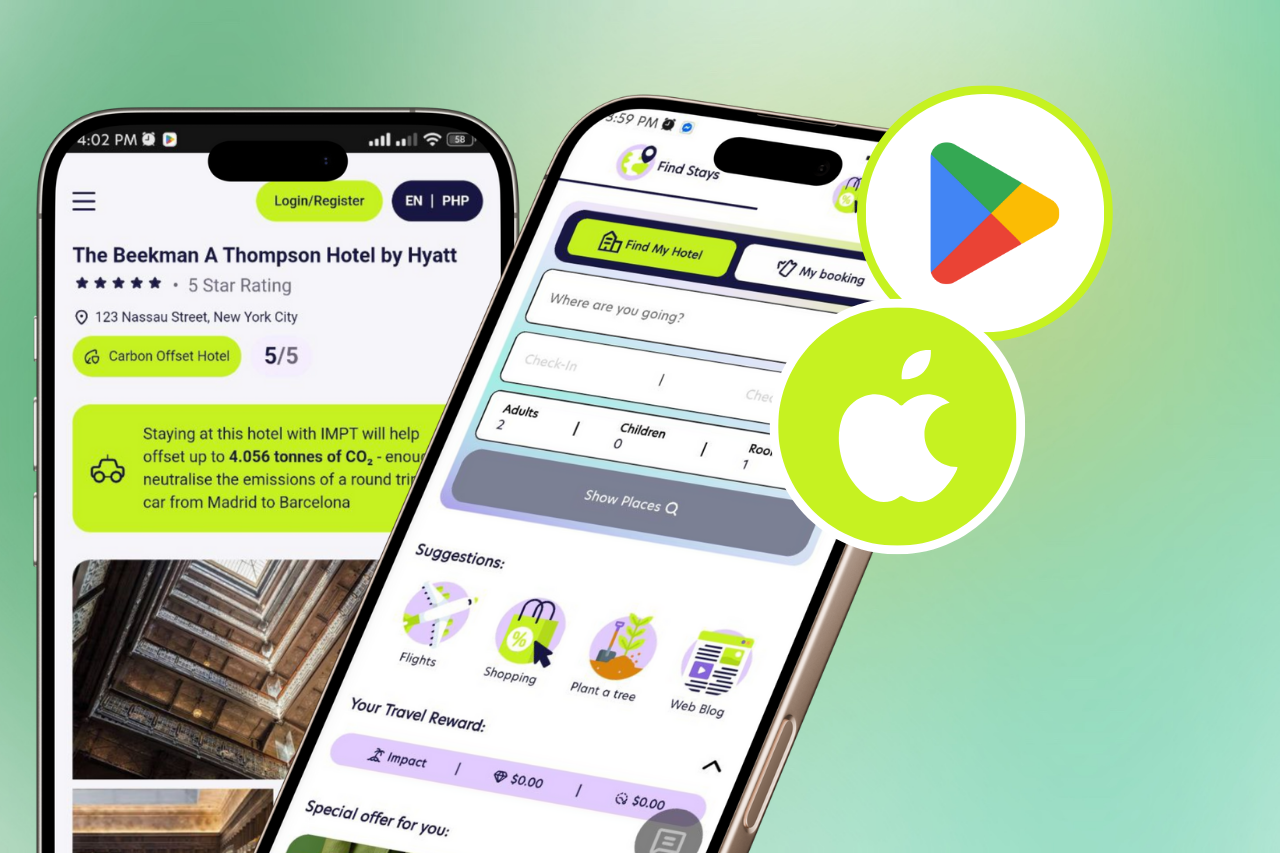
Booking through IMPT changes the economics of an eco-stay. Every confirmed booking on the platform triggers the purchase and retirement of 1 tonne of UN-verified carbon credits — funded entirely from our commission, not added to the room rate. The credits are sourced from Gold Standard and Verra-registered projects, with retirement evidence available to every guest on request. For an Irish hotel stay, that 1-tonne offset typically covers the full domestic carbon footprint of a two-night booking including local transport and food. We do not list properties that fail the Green Key, Fáilte Ireland Charter or EU Ecolabel threshold — the 22 hotels above are the verified set for 2026. Use the search below to check live availability across the Irish inventory, with dates pre-filled for a sample two-night stay. Adjust the dates, party size and city filters once the results page loads.
Frequently Asked Questions
What is a Green Key certified hotel?
Green Key is an international ecolabel for accommodation, administered in Ireland by An Taisce. To hold the certification, a hotel must meet around 100 criteria covering water use, waste segregation, energy consumption, chemical reduction, food sourcing, and staff training. Roughly 75 Irish properties currently hold the badge, and re-audits run annually. Green Key is the most widely held credential among Irish hotels and is the minimum benchmark we apply for inclusion on IMPT’s eco-hotel inventory.
Are there carbon-neutral hotels in Ireland?
“Carbon-neutral” is a contested claim. A small number of Irish hotels — including Celtic Ross and parts of the Powerscourt estate — publish verified annual emissions and offset the residual through registered carbon projects. The Fáilte Ireland Sustainability Charter does not certify carbon neutrality directly but requires a measured reduction plan. Treat any “carbon-neutral” label with healthy scepticism unless the property publishes both its emissions data and the retirement evidence for its offsets.
Best time to visit Ireland for eco-travel?
May, June and September give the best combination of long daylight, manageable rainfall and lower visitor pressure on sensitive sites such as the Burren, Skellig coast and Wicklow Mountains. July and August are peak season — book six months out for the Wild Atlantic Way. October to March offers genuine dark-sky viewing in the Kerry, Mayo and Tipperary reserves, and shoulder-season rates that reduce the per-night carbon and water footprint of the operation.
Is glamping a sustainable option in Ireland?
Sometimes. A genuine eco-glamping site will run off-grid solar, harvested rainwater and composting loos — but many sites use the “eco” label loosely. Look for Green Key certification, an explicit grid-status statement, and clarity on water source and waste handling. We maintain a separate verified list of 15 eco-glamping sites; the structures, certifications and infrastructure are documented entry by entry, so you can compare against the same criteria used for the hotels above.
Wild Atlantic Way vs East Coast for eco-travel?
The Wild Atlantic Way concentrates the highest density of conservation-managed estates, marine protected zones and dark-sky reserves — but it requires more driving between stops, which adds to the trip’s emissions. The east coast, anchored on Dublin and Wicklow, offers lower-carbon access by public transport and rail, with strong individual properties but fewer landscape-scale conservation programmes. For a low-carbon city-plus-mountain combination, Dublin and Wicklow are the practical choice; for landscape immersion, the Atlantic coast is the stronger option.
Do Irish hotels accept crypto?
Direct crypto acceptance at Irish hotel front desks remains rare. The practical route is to book through IMPT, where bookings can be paid in IMPT tokens, USDC or fiat — the hotel receives standard currency settlement, and the guest retains the offset and token-based reward layer. This avoids the volatility and chargeback issues that have kept most Irish hospitality operators away from direct crypto payment terminals.