SUMMER 2026 · 8 destinations

Moroccan Summer in Morocco.

From Atlantic surf towns to medieval medinas and the Saharan dunes — eight Moroccan destinations where summer 2026 splits sharply between the cool ocean coast and the inland furnace, and where one of the world's largest solar complexes is quietly rewriting the country's electricity grid.

8 destinations 1 ton CO₂ removed per booking 100% UN-verified
Find your Morocco eco-stay →

Same price as direct · 1 ton CO₂ removed per booking

Morocco's electricity grid has hit roughly 20% renewables, anchored by the Noor Ouarzazate solar complex — one of the largest concentrated-solar plants in the world — plus a major onshore-wind build-out across Tangier, Tarfaya and Laayoune. The country's 2030 target is 52% renewable, and the ONCF rail network (including the LGV Al Boraq high-speed line from Casablanca to Tangier in 2h10) means the entire Atlantic coast is now reachable car-free in a single afternoon. Summer is the country's hardest season to plan — inland Marrakech and Fes routinely hit 40°C+, while the Atlantic coast (Essaouira, Agadir, Casablanca) stays a comfortable 22–26°C with reliable trade winds.

Every reservation below removes one verified tonne of CO₂ through IMPT's offset programme — paid from our commission, never added to your bill. The eight destinations span the imperial cities (Marrakech, Fes), the Atlantic coast (Casablanca, Essaouira, Agadir, Tangier), the blue-painted Rif (Chefchaouen) and the Saharan threshold (Merzouga) — each chosen for what they offer in the sharp summer climate split.

Top 8 eco destinations in Morocco

Marrakech eco-travel in Morocco #1
South

Marrakech

The Red City is Morocco's headline image — Jemaa el-Fnaa at sunset, the Koutoubia minaret silhouette, the souks of the medina, and the Majorelle and Menara gardens. Summer days routinely hit 38–42°C, but the riads of the medina were designed for exactly this climate — thick mudbrick walls, central courtyards with shaded pools, and rooftop terraces that come alive after sunset. The new tram, the airport's solar canopy and the riad-cluster's investment in greywater systems make the city a serious sustainability story.

Highlights: Jemaa el-Fnaa night market · Majorelle Garden & YSL Museum · Bahia Palace & medina souks · Atlas Mountains day trip

Best: Mar–May, Oct Browse stays →
Fes eco-travel in Morocco #2
North

Fes

The largest medieval Islamic city still functioning as a living medina — Fes el-Bali is a UNESCO site of 9,000 narrow alleys, the Al-Karaouine library (the oldest continuously operating university in the world, founded 859), and the Chouara tanneries colour-blocked across the old town. Summer is hot inland (34–38°C), but the riads run on the same thick-wall thermal design as Marrakech. The high-speed Al Boraq train links Fes to Tangier in 3h10 via Casablanca.

Highlights: Fes el-Bali medina (UNESCO) · Chouara tanneries · Al-Karaouine university · Bou Inania Madrasa

Best: Mar–May, Oct Browse stays →
Casablanca eco-travel in Morocco #3
Coast

Casablanca

Morocco's commercial capital and the country's main aviation hub — Casablanca is the Atlantic-coast counterweight to the inland imperial cities. The Hassan II Mosque is one of the largest in the world, half-built over the Atlantic, with a 210-metre minaret. Summer temperatures stay a comfortable 22–26°C thanks to the ocean. The Al Boraq high-speed train runs to Tangier in 2h10, Marrakech in 2h50, and the city's tram network covers downtown plus the Corniche.

Highlights: Hassan II Mosque · Corniche & Ain Diab beach · Old Medina & Habous quarter · Morocco Mall & Anfa

Best: Apr–Oct Browse stays →
Chefchaouen eco-travel in Morocco #4
Rif

Chefchaouen

The blue-painted town of the Rif Mountains is one of Morocco's most photographed destinations — narrow alleys washed in shades of indigo, a tight medina built into the hillside at 560 metres, and the Talassemtane National Park on its doorstep. The elevation keeps summer comfortably in the high 20s°C, several degrees cooler than the coast. Reach it by 3-hour bus from Tangier or Fes; there's no train station, but a CTM coach connection is the cleanest car-free option.

Highlights: Blue-washed medina · Plaza Uta el-Hammam · Talassemtane National Park hike · Spanish Mosque viewpoint

Best: Apr–Oct Browse stays →
Essaouira eco-travel in Morocco #5
Coast

Essaouira

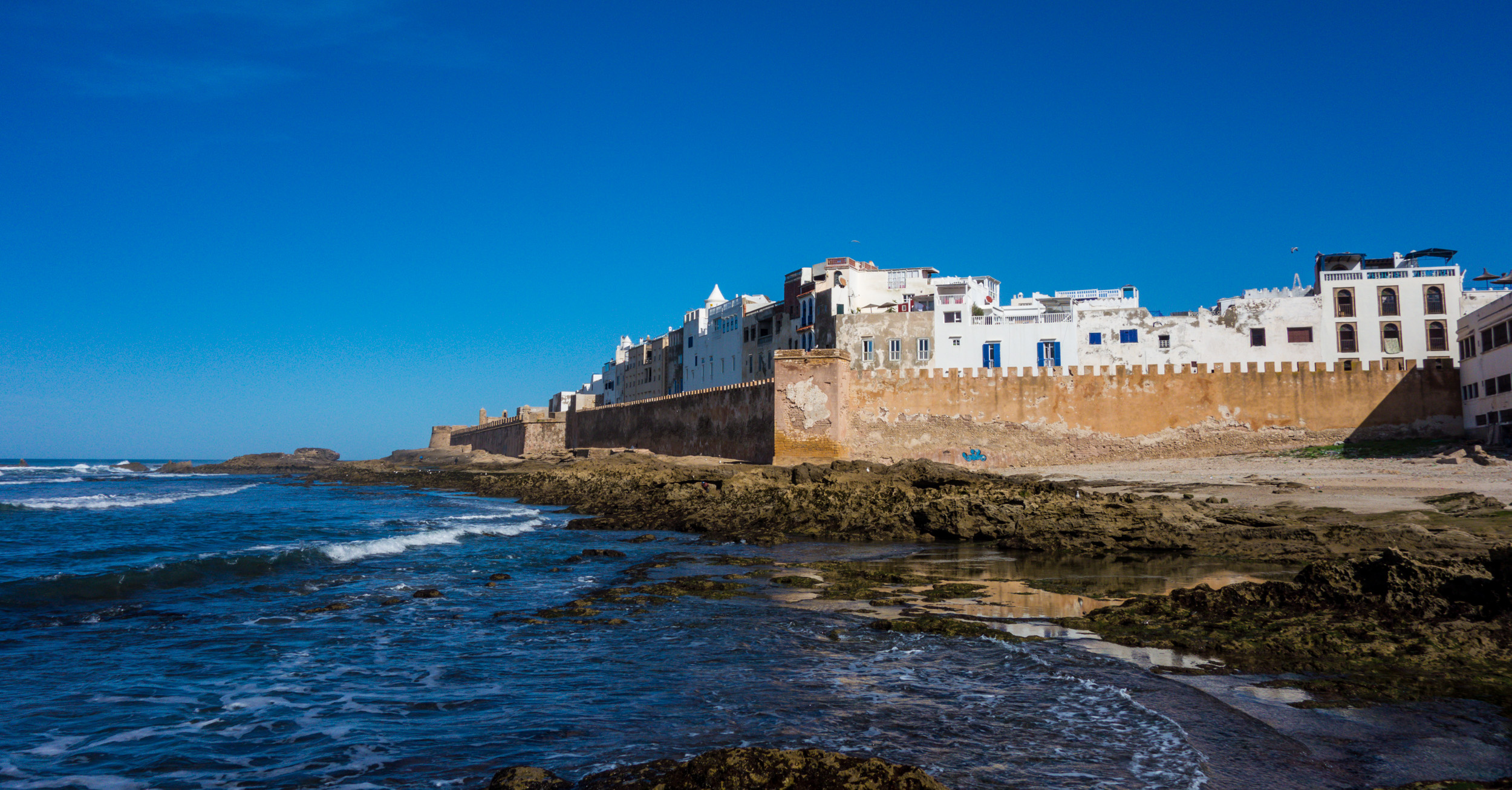
The Atlantic windsurf capital and Morocco's most relaxed coastal medina — a UNESCO-listed Portuguese fortress town with whitewashed walls, blue shutters and reliable summer alizés trade winds that keep the beach in the low 20s°C while Marrakech bakes inland. The kitesurfing and windsurfing scene is world-class from April to October, the Gnaoua World Music Festival fills the medina in late June, and the small-scale eco-riads inside the ramparts run on rooftop solar.

Highlights: UNESCO ramparts & medina · Windsurf & kitesurf beaches · Gnaoua Festival (late June) · Sidi Mohammed Ben Abdellah Museum

Best: Apr–Oct Browse stays →
Tangier eco-travel in Morocco #6
North

Tangier

Africa's gateway to Europe — Tangier sits at the Strait of Gibraltar, 14 km from Spain, with the LGV Al Boraq high-speed train putting Casablanca within 2h10. The medina has been carefully restored over the last decade (the Petit Socco, the Kasbah, the American Legation Museum), the city's grid runs increasingly on the Tarfaya and Tangier wind farms (cumulative ~1.5 GW), and the Tanger-Med port is one of Africa's busiest. Cooler summer temperatures (22–28°C) make it an excellent climate alternative to the inland imperial cities.

Highlights: Medina & Kasbah · Cap Spartel & Caves of Hercules · American Legation Museum · LGV Al Boraq to Casablanca

Best: Apr–Oct Browse stays →
Agadir eco-travel in Morocco #7
South

Agadir

Morocco's biggest Atlantic resort city — a 10 km golden-sand beach, year-round mild climate (25°C average even in July), and the Souss-Massa National Park immediately south for birdwatching and Argan-tree forest. Agadir was rebuilt after the 1960 earthquake on a modern grid plan, which makes it the country's most walkable coastal city. The eco-resorts on the Taghazout and Tamraght surf strip just north have driven a small Atlantic surf-and-yoga economy that runs on rooftop solar.

Highlights: Agadir beach & Marina · Souss-Massa National Park · Taghazout surf strip · Kasbah Agadir Oufella viewpoint

Best: Year-round Browse stays →
Merzouga eco-travel in Morocco #8
Sahara

Merzouga

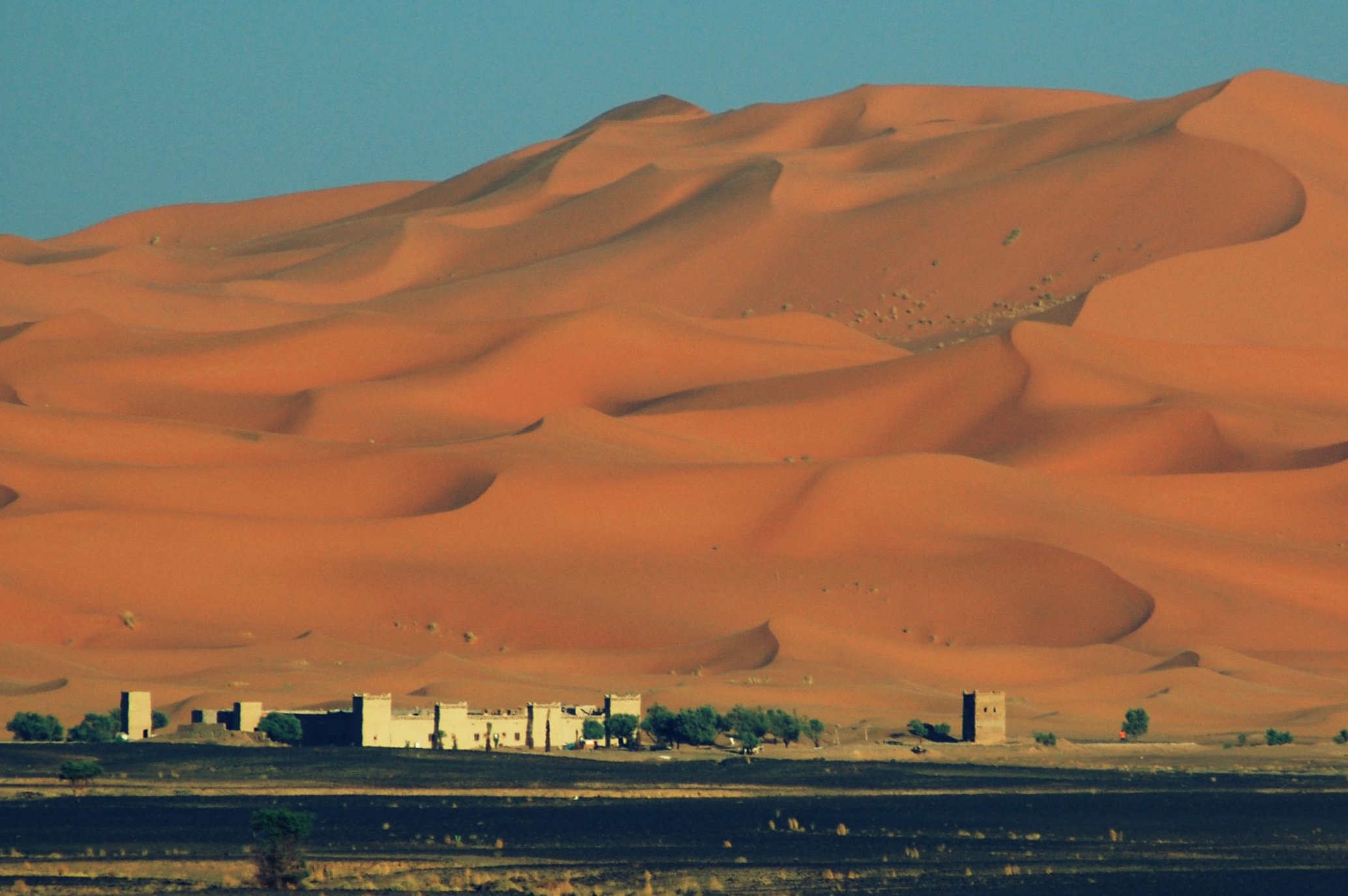
The threshold of the Sahara — the Erg Chebbi dunes rise 150 metres above the surrounding hamada, and the desert camps outside the village have become Morocco's signature sustainable-luxury experience. Summer is not the recommended season (daytime highs hit 45°C+ in July–August), but mid-September through April is excellent and many camps run on solar-and-battery microgrids. Reach it by 10-hour drive from Marrakech or 8-hour drive from Fes through the High Atlas via Aït Ben Haddou and Ouarzazate.

Highlights: Erg Chebbi dunes camel trek · Sahara overnight desert camp · Ait Ben Haddou kasbah (UNESCO) · Ouarzazate film studios

Best: Oct–Apr Browse stays →

Why summer eco-travel in Morocco?

Morocco sits at the structural intersection of fast-scaling renewables (the Noor Ouarzazate solar complex is among the world's largest, with the country targeting 52% renewable electricity by 2030), a high-speed rail spine that now links Tangier, Casablanca, Rabat and Fes car-free in a single afternoon, and a climate split sharp enough that the Atlantic coast (Essaouira, Agadir, Casablanca, Tangier) stays a comfortable mid-20s°C through July and August while inland Marrakech and Fes routinely top 40°C. For summer travellers, that means basing on the Atlantic and day-tripping to the imperial cities is the climate-smart pattern; for autumn, the inland and Saharan circuits open up. IMPT layers a UN-verified 1-ton CO₂ removal on every booking — at no extra cost, paid from our commission.

Frequently asked questions

When is the best time to visit Morocco for a sustainable summer?

For the Atlantic coast (Essaouira, Agadir, Casablanca, Tangier), the whole summer is comfortable — 22–26°C with reliable trade winds. For the inland imperial cities (Marrakech, Fes) and the Sahara (Merzouga), summer is the hardest season — daytime highs of 40°C+ are routine, and the dunes are not a recommended overnight in July–August. The cleanest compromise is to base on the coast in June through August and shift inland in September or October.

What are the logistics of a Sahara desert tour from Merzouga?

Most Merzouga overnight desert experiences are 2-day or 3-day circuits from Marrakech or Fes. The 3-day route via Aït Ben Haddou, the Dades and Todra gorges, and the Erg Chebbi dunes is the standard. Camps range from basic Berber tents to luxury solar-powered glamping. Camel trek to camp at sunset, dinner under the stars, sunrise from the high dunes the next morning. Avoid July and August — overnight lows are still mid-30s°C and the camps don't run cooling.

How do I travel between Moroccan cities without a car?

The ONCF rail network covers all the imperial and coastal cities. The LGV Al Boraq high-speed line links Tangier — Kenitra — Rabat — Casablanca in 2h10, and connects to Marrakech (4h50 total) and Fes (3h30 total). The CTM and Supratours coach networks fill in everywhere the train doesn't reach (Chefchaouen, Essaouira, Merzouga). For the Sahara leg, organised tours from Marrakech or Fes are the most practical option.

Are eco-hotels in Morocco more expensive than regular hotels?

No. Booking through IMPT costs the same as booking direct — the carbon removal is paid from our commission, not added to your bill. Moroccan hotel rates spike around Ramadan, Eid al-Fitr, Eid al-Adha (dates shift each year on the Gregorian calendar), and the European school holidays in July–August — that's pure supply-and-demand, not an eco-premium.

Which Moroccan destination is best for a first-time visitor?

Marrakech + Essaouira + Fes is the classic first-timer triangle — three nights in Marrakech for the medina and gardens, the 3-hour drive (or coach) west to Essaouira for two days on the cooler Atlantic coast, then the train through Casablanca to Fes for two nights of medieval medina. Add the Sahara at the end (3-day organised circuit) if you have a full ten days and the season is right.

How does IMPT make a Moroccan hotel booking carbon-neutral?

Every reservation triggers a verified one-tonne CO₂ removal — UN-certified, paid from our commission. The offset is sourced from a portfolio of reforestation and renewable-energy projects in the Mediterranean basin and East Africa, and is enough to fully balance a typical European or transatlantic flight to Morocco plus a 4-night stay. See how we carbon-balance every stay.

Plan a Morocco summer that gives back

Same price as direct booking. No hidden fees. Every reservation removes one UN-verified ton of CO₂ — paid from our commission, never added to your bill.

Search 8 Morocco destinations →