SUMMER 2026 · 8 destinations

Croatian Summer in Croatia.

The Dalmatian island chain, the Istrian peninsula and the walled Adriatic cities — eight Croatian destinations where summer 2026 can be both unforgettable and carbon-balanced.

8 destinations 1 ton CO₂ removed per booking 100% UN-verified
Find your Croatia eco-stay →

Same price as direct · 1 ton CO₂ removed per booking

Croatia generates around 55% of its electricity from renewables — overwhelmingly hydropower, with rapidly-growing solar capacity along the Adriatic coast — and the EU Modernisation Fund is on track to push the share above 65% by 2030. The country runs Europe's most concentrated network of UNESCO sites per capita (10 sites in a country of 3.8 million), eight national parks (Plitvice and Krka are the headline names), and a coastal-protection regime that has kept the 1,200-island Adriatic chain remarkably free of overdevelopment. Layer on Travelife, Green Key and the homegrown "Sustainable Hotel" mark from the Croatian Sustainable Tourism Cluster, plus the densest passenger-ferry network in the Adriatic (Jadrolinija serving 50+ islands), the 2022-opened Pelješac Bridge that finally made the coast road continuous, and a national bike-route programme (EuroVelo 8 and the Parenzana) that now covers Istria end-to-end — and Croatia becomes one of the most structurally low-carbon Mediterranean destinations a traveller can pick for 2026.

Every reservation below removes one verified ton of CO₂ through IMPT's offset programme — paid from our commission, never added to your bill. The eight destinations span the continental capital (Zagreb), the Dalmatian walled cities (Split, Dubrovnik, Zadar, Trogir), the central Adriatic islands (Hvar), and the Istrian peninsula (Rovinj, Pula) — each chosen for sustainability infrastructure as much as for stone-and-sea atmosphere.

Top 8 eco destinations in Croatia

Zagreb eco-travel in Croatia #1
Centre

Zagreb

Croatia's Central European capital is split between the medieval Upper Town (Gornji Grad) of red-tiled roofs and the 19th-century Lower Town's grid of Habsburg parks (the so-called Green Horseshoe). The funicular up to Gradec is one of the world's shortest; the Museum of Broken Relationships is one of its most original. Zagreb is the natural overland entry to the Adriatic — the new Pelješac and the 2026-rehabbed Zagreb–Split motorway make the coast a four-hour drive south.

Highlights: Upper Town & funicular · Cathedral & Dolac market · Museum of Broken Relationships · Green Horseshoe parks

Best: May–Sep Browse stays →
Split eco-travel in Croatia #2
Dalmatia

Split

Dalmatia's de facto capital is built inside and around Diocletian's Palace — a 4th-century Roman emperor's retirement complex that became a UNESCO World Heritage Site and remains a living quarter of bars, apartments and chapels woven into the Roman walls. The Marjan peninsula gives the city a forested park headland with swimming coves; the Jadrolinija ferry hub at the eastern port connects to Hvar, Brač, Vis and Korčula. Stay inside or just outside the Palace walls.

Highlights: Diocletian's Palace (UNESCO) · Riva promenade · Marjan Hill park · Bačvice beach

Best: May–Sep Browse stays →
Dubrovnik eco-travel in Croatia #3
Dalmatia

Dubrovnik

The Pearl of the Adriatic — a Venetian-Ragusan walled city whose 1.9 km of intact stone walls circle the entire UNESCO core. Cruise-ship caps introduced in 2019 have eased the worst of the daytime crowds; the smart move is to overnight in the Old Town, walk the walls at dawn or dusk, and take the cable car up Mount Srđ for the wide view of the Elaphiti Islands. The Pelješac Bridge (opened 2022) made the coastal drive to Split fully continuous.

Highlights: City walls walk · Stradun & Old Town (UNESCO) · Mount Srđ cable car · Lokrum island ferry

Best: May–Sep Browse stays →
Hvar eco-travel in Croatia #4
Dalmatia

Hvar

Croatia's sunniest island (2,800+ hours a year) and the central Dalmatian hub for lavender, rosemary and old-vine Plavac Mali wine. Hvar Town's Venetian arsenal, the Spanjola fortress and the car-free Pjaca anchor the centre; the Pakleni Islands sit a 10-minute boat hop offshore and remain protected from build-up. Stari Grad, on the north coast, holds a UNESCO-listed Greek field-system (the Chora) still farmed under its original 4th-century BC parcel lines.

Highlights: Hvar Town & Pjaca · Spanjola fortress · Pakleni Islands boat · Stari Grad Plain (UNESCO)

Best: Jun–Sep Browse stays →
Rovinj eco-travel in Croatia #5
Istria

Rovinj

The Istrian peninsula's most photogenic town — a Venetian-era fishing port whose old town spirals up a tied-island promontory crowned by St. Euphemia's bell tower. Rovinj sits at the heart of Croatia's olive-oil belt (Istria has the world's highest concentration of award-winning extra-virgin estates per capita) and the Lim Fjord and Cape Kamenjak nature reserves bookend the coast either side. The Parenzana cycle route runs 123 km inland through Motovun and Grožnjan.

Highlights: Old town & St. Euphemia · Cape Kamenjak reserve · Lim Fjord · Parenzana cycle route

Best: May–Sep Browse stays →
Zadar eco-travel in Croatia #6
Dalmatia

Zadar

The northern Dalmatian gateway with a Roman forum still in everyday use, Nikola Bašić's Sea Organ (steps that play music with the waves) and the Greeting to the Sun solar installation on the western quay. Zadar is the closest base to the Plitvice Lakes (UNESCO) and the Kornati National Park's 89-island archipelago, both reachable on long day trips. The Pag bridge connects to Pag island, source of Croatia's famous sheep's-milk cheese.

Highlights: Sea Organ & Greeting to the Sun · Roman forum · Plitvice Lakes day trip · Kornati islands

Best: May–Sep Browse stays →
Trogir eco-travel in Croatia #7
Dalmatia

Trogir

A UNESCO-listed Romanesque-Gothic island town 20 minutes from Split airport — small enough to walk in 15 minutes, ringed by a seafront promenade and the Kamerlengo Fortress at its western tip. Trogir is the quiet alternative to Split for a Dalmatian base, with easy ferry connections out to Drvenik Veli and the Šolta and Brač islands. The interior of the cathedral (the Portal of Radovan) is one of the great masterpieces of Croatian medieval sculpture.

Highlights: UNESCO old town · Kamerlengo Fortress · Cathedral & Portal of Radovan · Drvenik Veli boat trip

Best: May–Sep Browse stays →
Pula eco-travel in Croatia #8
Istria

Pula

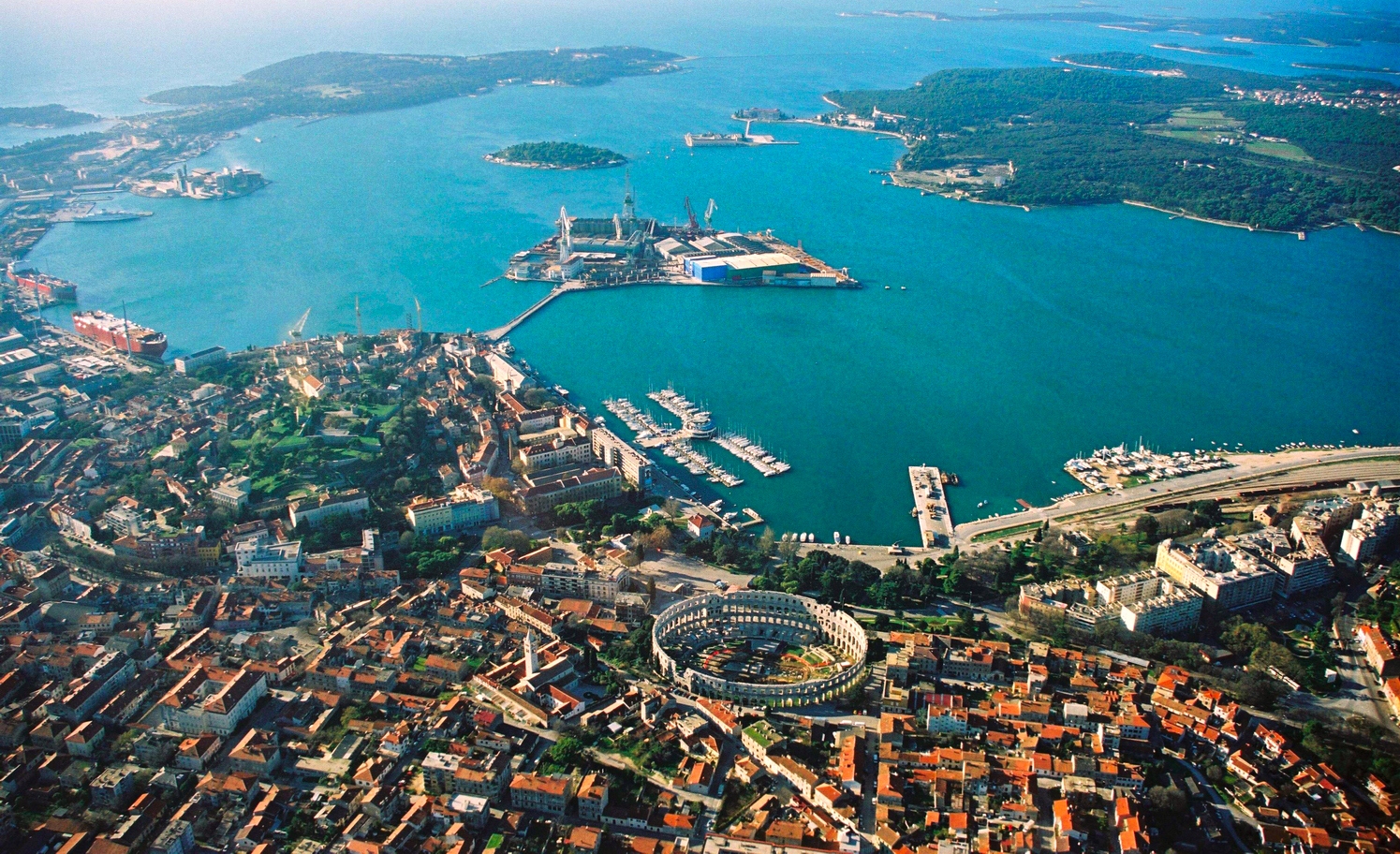
The southern tip of the Istrian peninsula crowned by one of the six largest surviving Roman amphitheatres in the world — the Pula Arena, still in active use for the summer film festival and concerts. The Brijuni Islands National Park sits 15 minutes north by boat (Tito's former summer residence and a Mediterranean wildlife reserve), and Cape Kamenjak — Istria's wild rocky cape — rolls south into the Adriatic. Stay in the old town or out at Verudela for a beach-side base.

Highlights: Pula Arena · Brijuni National Park · Cape Kamenjak · Temple of Augustus

Best: May–Sep Browse stays →

Why summer eco-travel in Croatia?

Croatia sits at the structural intersection of a 55% renewable electricity grid (overwhelmingly hydropower, rising on solar), eight national parks and twelve nature parks covering nearly 9% of the territory, and ten UNESCO sites in a country of 3.8 million — the densest concentration in Europe per capita. The Jadrolinija ferry network covers 50+ Adriatic islands at a fraction of the per-passenger emissions of any short-haul flight, and the country's coastal-construction laws have preserved a 1,200-island archipelago that competing Mediterranean coasts long ago surrendered. Travelife, Green Key and the homegrown "Sustainable Hotel" mark are increasingly standard across the boutique segment. IMPT layers a UN-verified 1-ton CO₂ removal on every booking — at no extra cost, paid from our commission.

Frequently asked questions

When is the best time to visit Croatia for a sustainable summer?

Late May, June and September are the sweet spot — Adriatic temperatures sit at 22–27°C, the sea is warm enough to swim from early June, the ferries run a full schedule, and rates run 30–45% below the August peak. July and August see the heaviest cruise-ship and yacht traffic on the Dalmatian coast and the highest air-con load on the islands; if you have the flexibility, shift to the shoulder weeks.

How do I get between Croatian islands without a private boat?

Jadrolinija is the national operator and runs the densest ferry and catamaran network on the Adriatic — Split is the main hub for Hvar, Brač, Vis and Korčula; Zadar covers the Kornati and Pag; Dubrovnik runs to Mljet and the Elaphiti Islands. Per passenger, a Croatian ferry emits roughly 65–75% less CO₂ than the equivalent short-haul flight, and the views beat any aircraft window.

Are eco-hotels in Croatia more expensive than regular hotels?

No. Booking through IMPT costs the same as booking direct — the carbon removal is paid from IMPT's commission, not added to your bill. Croatian hotel rates spike around the Ultra Europe festival in Split (mid-July), the Dubrovnik Summer Festival, and the first two weeks of August when most of central Europe is on holiday — that's pure supply-and-demand, not an eco-premium.

Which Croatian destination is best for first-time visitors?

Split + Hvar + Dubrovnik is the classic Dalmatian triangle — fly into Split, three nights in the Palace, two on Hvar by morning catamaran, then a coastal drive or coach south to Dubrovnik for three more nights. If you prefer cooler temperatures and quieter towns, Istria (Rovinj + Pula) is the better first-timer pick, ideally paired with two nights in Zagreb on either end.

How does IMPT make a Croatian hotel booking carbon-neutral?

Every reservation triggers a verified one-tonne CO₂ removal — UN-certified, paid from our commission. The offset is sourced from a portfolio of reforestation and renewable-energy projects in the Mediterranean basin and East Africa, and is enough to fully balance a typical short-haul flight to Zagreb, Split or Dubrovnik plus a 4-night stay. See how we carbon-balance every stay.

Can I drive the Croatian coast in an EV?

Yes — the Croatian motorway network is the best-charged on the eastern Adriatic, with HEP ELEN, Petrol Tesla Superchargers and IONITY hubs at most major rest stops. Coverage on the Magistrala coast road (D8) thins past Šibenik but is improving fast. The Pelješac Bridge (opened 2022) means you no longer cross into Bosnian territory en route from Split to Dubrovnik, which simplifies EV-charging logistics.

Plan a Croatia summer that gives back

Same price as direct booking. No hidden fees. Every reservation removes one UN-verified ton of CO₂ — paid from our commission, never added to your bill.

Search 8 Croatia destinations →